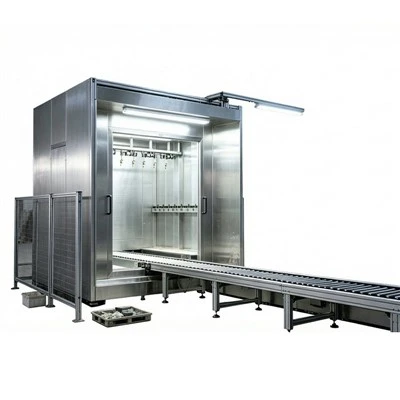
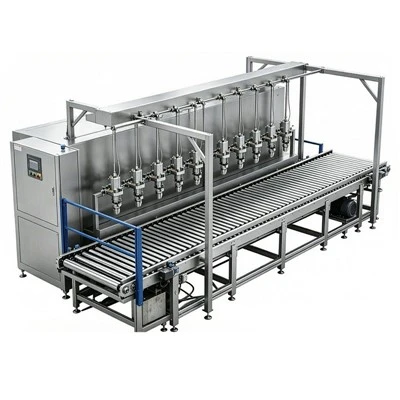
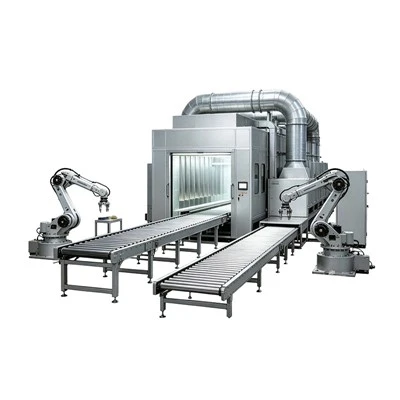
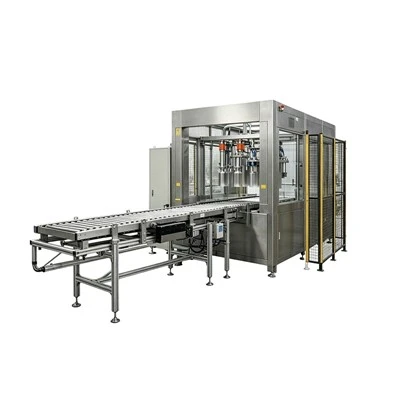
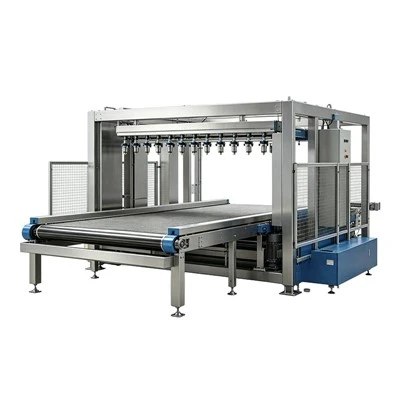
Automated spray coating production lines typically consist of multiple subsystems working in concert, including the conveying system, spraying robots, coating supply system, atomization unit, drying and curing system, and the control center. These components operate in precise coordination to form a comprehensive spray coating processing system.
The conveying system is responsible for transporting products to the spraying zone along a preset path and at a specific speed. It can be configured flexibly-using overhead chains, floor-mounted conveyors, or robotic handling-based on product characteristics and production requirements. A stable conveying process ensures accurate product positioning within the spraying zone, laying the foundation for subsequent coating operations.
Spraying robots serve as the core component of the automated system, utilizing multi-jointed robotic arms to achieve flexible movement. Equipped with specialized spray guns at the end-effector, these robots can execute complex trajectories in 3D space according to programmed instructions. Compared to manual spraying, robotic systems offer superior trajectory precision, consistent speed, and high repeatability.
The coating supply system transports coating material from storage containers to the spray gun, utilizing components such as pumps, piping, and pressure tanks. It precisely controls flow rate and pressure to ensure a stable output during the spraying process. The system also features viscosity control mechanisms to maintain the coating in an optimal state for application.
The atomization unit employs a specialized design to break the coating material down into uniform, fine droplets. Common atomization methods include air atomization, electrostatic atomization, and high-speed rotary atomization. Effective atomization ensures an even distribution of coating across the product surface, resulting in a smooth, uniform finish.
The drying and curing system processes the coated products to ensure the coating achieves its intended performance characteristics. Depending on the coating type, methods such as air drying, hot air circulation, infrared radiation, or UV curing may be employed. An appropriate drying process effectively enhances coating adhesion and surface hardness.
Acting as the system's "brain," the control center manages all subsystems via programmable controllers and industrial computers. Operators use a human-machine interface (HMI) to configure process parameters, monitor operational status, and adjust production pacing, thereby achieving precise control over the entire spraying process.