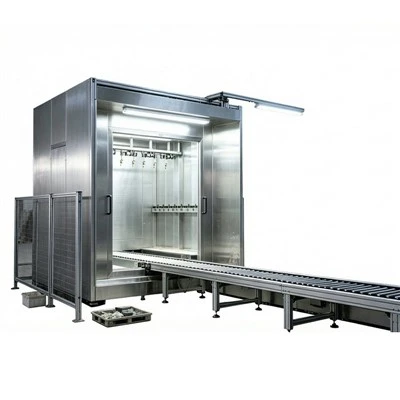
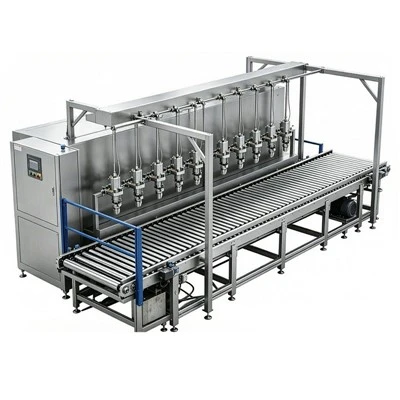
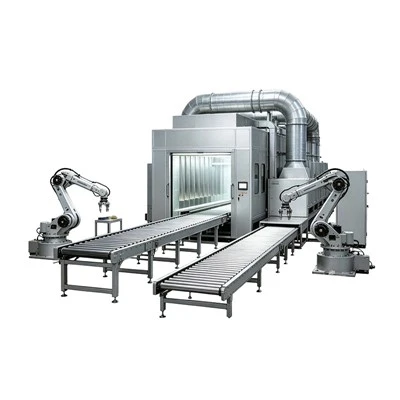
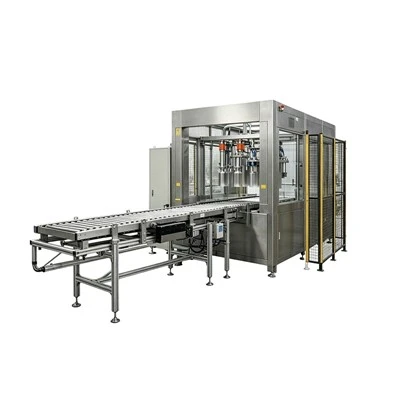
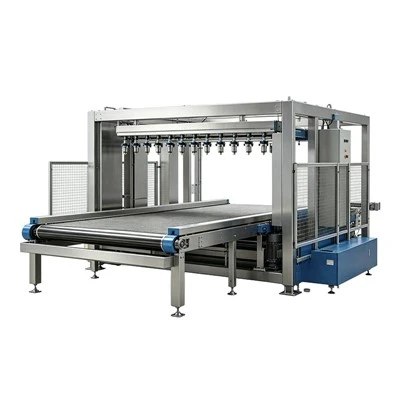
Based on the level of automation, spraying equipment can be categorized into manual, semi-automatic, and fully automatic systems. Representative examples of automatic spraying equipment include reciprocating sprayers and spraying robots (robotic arms).
Reciprocating sprayers are custom-engineered equipment, manufactured to meet specific customer requirements regarding the workpieces to be coated. They offer high spraying speeds for simple workpieces but have a more limited scope of application, being primarily used for large, flat-surfaced items. For complex workpieces or specific areas, manual touch-up spraying is often required after the automated process.
Spraying robots represent a higher level of automation and efficiency; their core components include the robot arm itself, a computer, and a corresponding control system. Advanced models feature flexible wrists that allow for agile movement, enabling easy spraying of the internal surfaces of workpieces.
Thanks to their high flexibility and precision, robotic spraying systems can handle workpieces of various complex shapes and sizes, significantly boosting production efficiency and ensuring consistent quality. These robots can be further classified based on different criteria: by spraying principle (air-assisted/low-pressure air spraying vs. airless spraying for high-viscosity paints); by mobility along the conveyor line (track-mounted vs. stationary/fixed-mount); and by installation method (floor-mounted vs. cantilever-mounted).