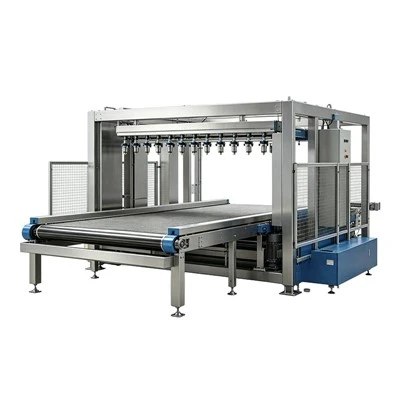
Production efficiency is a key indicator of manufacturing capability, and automated spraying equipment drives significant improvements in this area through several factors.
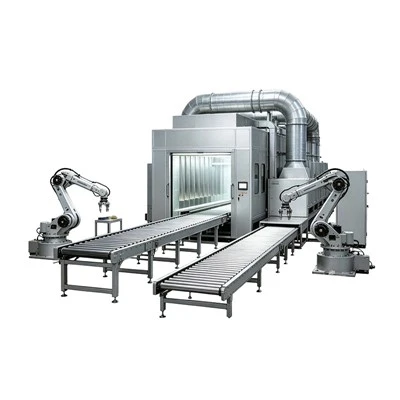
First is the substantial increase in production speed. Automated spraying equipment enables continuous, uninterrupted operation, overcoming the physical limitations inherent in manual spraying. Spraying robots can operate around the clock while maintaining a consistent pace. Statistics show that adopting automated spraying can increase product throughput per unit of time several-fold compared to manual methods.
Second is the reduction in time required for color and material changes. Modern automated spraying systems feature rapid color-change mechanisms, allowing for the switching of coating colors in a very short time. Traditional manual spraying requires halting production to clean lines and change materials-a time-consuming process. In contrast, automated systems use programmed controls to switch colors within minutes, drastically minimizing production downtime.
Third is the compression of production preparation time. Automated spraying equipment stores preset spraying programs for various products; when the production line needs to switch product types, operators simply select the appropriate program to begin work. By comparison, manual spraying requires retraining operators for new techniques whenever production changes, consuming a significant amount of time.
Fourth is the reduction of auxiliary time. Automated systems integrate various intelligent functions, such as automatically identifying product positioning, calculating optimal spray paths, and monitoring coating thickness in real-time. These features reduce the need for auxiliary tasks like system adjustments and measurements during production, thereby significantly increasing the proportion of time spent on actual spraying operations.
Finally, there is the optimized control of energy consumption. Automated spraying systems can precisely adjust energy supply based on actual production needs, preventing unnecessary waste. For instance, the system can automatically switch to an energy-saving mode during production pauses and resume operation immediately upon detecting an approaching product. This intelligent energy management not only lowers production costs but also enhances energy efficiency.